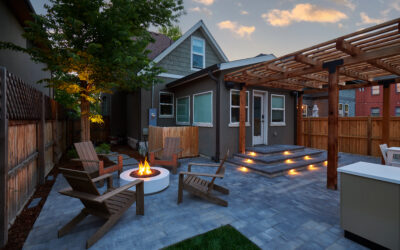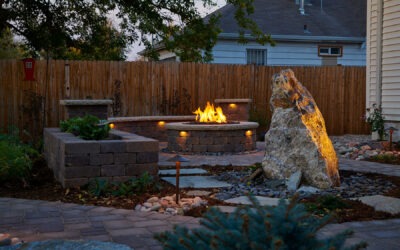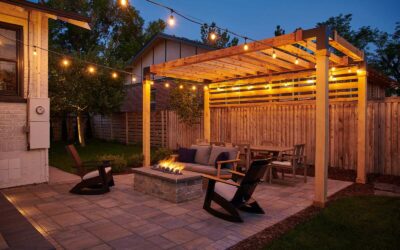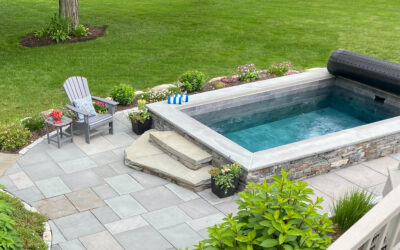
Winter is the season that shows what an outdoor lighting company in Englewood, CO actually built. A system that looked great in September either rides out a Front Range freeze cycle or starts losing fixtures one at a time in February. The difference comes down to burial depth, housing material and transformer sizing rather than how good the photos were.
Down to Earth Landscaping has designed and built outdoor living spaces in and around Englewood since 2012, and our team is a three-time ALCC award winner. Fourteen Colorado winters teach you which details hold and which ones turn into somebody else’s callback.
So here is the honest version: what altitude, freeze-thaw and the intense Colorado sun do to a low voltage system, and how lighting gets built into a project so it survives the climate it lives in.
Related: Create Inviting Evenings With Outdoor Lighting and Landscape Design in Castle Rock, CO
What Does Altitude Do to an Outdoor Lighting System?
Altitude ages the non-metal parts of a lighting system faster, because ultraviolet exposure at a mile up is meaningfully harsher than at sea level. Lenses haze, gaskets harden, plastic trim chalks, and cable insulation left above grade in full sun turns brittle years earlier than the catalog suggests.
The practical answer is to specify away from plastic wherever it carries a structural or sealing job. Cast brass and copper housings with glass lenses handle Colorado sun for the long haul. They cost more per fixture because they end the conversation about replacements.
How Does Freeze-Thaw Reach a Buried Cable?
Freeze-thaw reaches buried cable by moving the soil around it, because Front Range ground cycles through freezing and thawing many times each winter rather than freezing once. Cable laid shallow gets worked upward over a few seasons until a shovel, an edger or a dog finds it.
A well-built system buries runs below that working layer and routes them where they can be found again, along bed edges and hard surfaces rather than straight across open lawn. Anything crossing under paving goes in a sleeve, so a future repair is a pull rather than a demolition.
How Do Connections Decide a Lighting System’s Lifespan?
Connections decide lifespan because freeze-thaw drives water into anything that is not sealed. A pierce-point connector works fine on handover and corrodes quietly through two winters until the run dims or drops out entirely.
Does Snow Change Where Lighting Fixtures Can Go?
Snow changes fixture placement more than any other Colorado factor. A path light sited beautifully in July is a snowplow casualty in January, and a well light set in a low spot spends three months under meltwater.
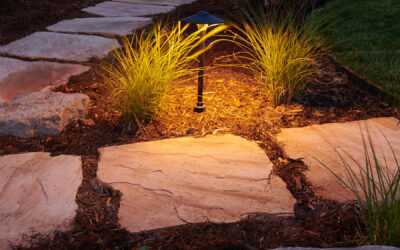
Good placement starts with the snow-removal route. Path fixtures stay off the shovel line and anything near a driveway edge moves to the planted side. A fixture that has to live in the firing line goes on a heavier stem or gives way to a wall-mounted or recessed hardscape unit with nothing to break off.
Snow load on a structure matters too. Lights mounted into a pergola or pavilion roof need their wiring and housings set so a loaded roof flexing in a March storm does not pull on a cable. That detail gets designed in at framing rather than added afterward.
Why Does Colorado Sun Change the Choice of Fixture Finish?
Colorado sun and regular maintenance traffic make finish a durability decision rather than a cosmetic one. A powder-coated aluminum fixture looks sharp until a trimmer chips the coating, and then the exposed aluminum corrodes outward from that point. That is a predictable failure rather than bad luck.
Solid brass and copper go the other way. They develop a patina that protects the metal underneath, and a scratch disappears into the finish rather than starting a problem. For a property where the lighting is meant to still be there in a decade, this is the simplest decision on the list.
Lamp color deserves the same attention. Warm color temperatures flatter the stone, cedar and steel common in Colorado outdoor living spaces, while cooler lamps make the same materials read gray and blue against the landscape.
How Is Lighting Built Into a Design-Build Project?
Lighting is built into a design-build project as a layer of the design, with the cable plan, sleeve locations and fixture positions drawn alongside the patio, the structure and the planting beds. Treating it as a separate trade added after the hardscape is finished is what produces visible cable and awkward fixtures.
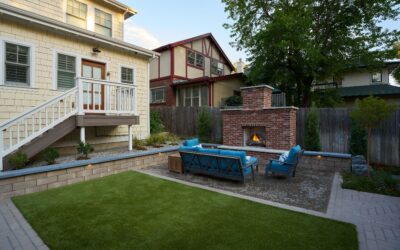
The reason is sequencing. Recessed hardscape lights in a seat wall cap or a step riser have to be set while the masonry goes up, and a fixture added later is surface-mounted with cable running where you can see it.
That integration also saves a trench. Where lighting, a gas line and a water feature all leave the house in the same direction, one excavation serves all three. Three separate visits across three seasons cost more and disturb a finished yard twice.
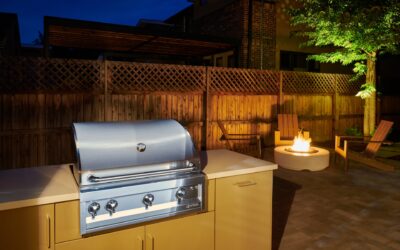
On our patio design and installation projects, the lighting plan is one of those shared layers.
What Lighting Does a Pergola Need That a Patio Does Not?
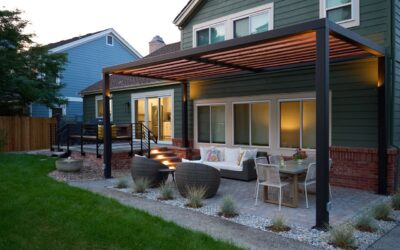
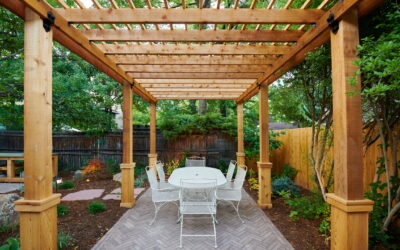
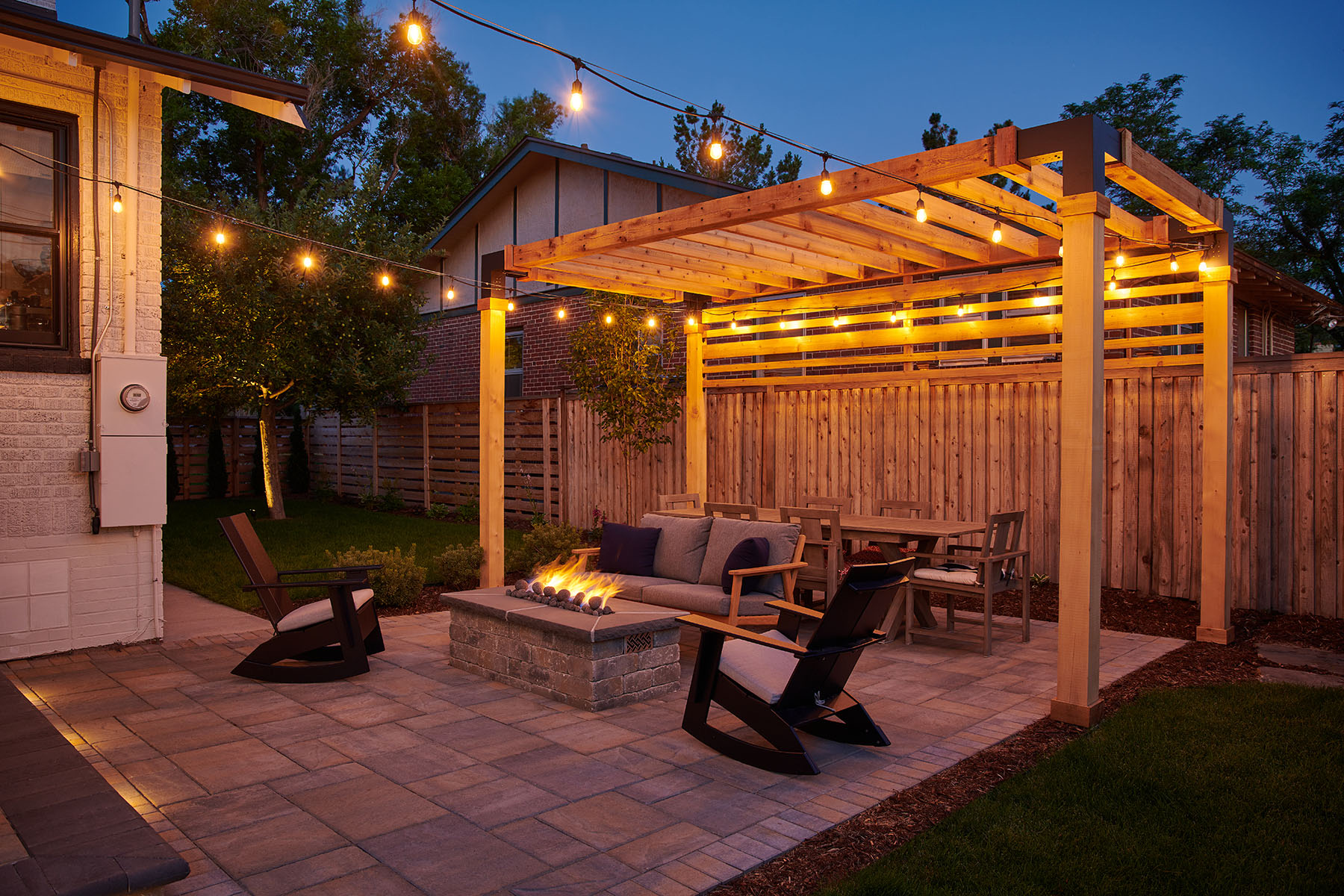
A pergola needs three separate layers of light on three separate controls: overhead light for the table, perimeter light at the beam line so the structure reads from across the yard, and task lighting at a counter or bar for the work that happens there.
Put all three on one switch and the space has one setting, usually too bright for sitting and too dim for cooking. Splitting them is a wiring decision made during framing and close to impossible to retrofit into a finished cedar ceiling.
That is the practical argument for deciding the lighting before the structure. Conduit and junction points go in while the posts are up and the roof is open, so nothing gets cut open afterward. That is why our pergola design and installation work plans the wiring with the frame.
How Big Should a Low Voltage Transformer Be?
A low voltage transformer should be bigger than the system needs on day one. A unit running near its ceiling runs hot and ages fast, and a Colorado property that adds a fire feature, a planting bed or a deck extension two years later wants to plug into the system it already owns.
Multiple taps earn their place on larger lots. Long runs lose voltage along the way, and feeding them from a higher tap brings the far fixtures back up to the same brightness and color as the ones near the house. Without that, one end of a property looks tired and nobody can say why.
Cable gauge is the other half of the same problem. Heavier cable on the long legs costs more per foot and solves voltage drop permanently, a far better trade than discovering it after the beds are mulched.
What Deserves to Be Lit on an Englewood Property?
Four or five well-lit features deserve the light on most Englewood properties, with everything else allowed to go dark. Light every tree, every path and every corner and the result reads like a parking lot with nicer plants.
A good scheme starts from where people actually look. The view from the kitchen window, the view from the main seating group and the approach from the driveway are the three that matter. A fixture that only reads from a spot nobody stands in is doing nothing.
After that it comes down to what a material does with light. A rough stone face grazed from close range shows every bit of its texture, while a smooth stucco wall lit the same way shows every imperfection. Steel takes light beautifully but bounces it hard, so it usually wants a lower wattage than people expect.
Trees are the exception worth spending on. A mature ponderosa or cottonwood uplit from two or three positions becomes the largest feature on the property for a fraction of what any built element costs, and it gets better every year.
How Do You Test Outdoor Lighting for Glare?
Testing for glare means sitting in every seat after dark and looking around. If a fixture puts light directly into your eye from a chair somebody will actually use, it is destroying night vision for the whole group and flattening everything else in the scheme.
Shields, louvers and hiding a fixture behind a plant mass solve almost all of it. Running that check with people sitting in the furniture is the difference between a yard that feels comfortable after dark and one that feels like a stage.
What Should an Outdoor Lighting Quote Include?
An outdoor lighting quote should name six things: fixture make, model and housing material; lamp wattage, color temperature and beam angle; transformer capacity against the connected load; cable gauge on each run; connection type; and what the installer warrants separately from the manufacturer.
That list turns two quotes into a comparison. Without it, a homeowner is comparing one fixture count against another, which says nothing about which system is still working in five years.
It also tells you something about the company. A contractor who can answer all six without looking anything up has thought about the system, and one who cannot has thought about the price.
Do Lighting Timers and Controls Earn Their Cost?
Lighting controls earn their cost because a mechanical timer set in June has the wrong schedule by October, as sunset shifts by several hours across a Colorado year. Most homeowners adjust it twice and then stop, so the system either burns all night or comes on after everyone has gone inside.
A photocell or an astronomic timer tracks actual sunset and removes the chore permanently. It is a small line on a proposal and the single change that makes people use a system the way they imagined using it.
Zoning is the upgrade worth considering beyond that. Splitting the property so the front approach, the entertaining area and the feature trees run on separate schedules lets the front light at dusk and shut down at eleven, while the patio stays on as long as anyone is sitting in it.
When Should Outdoor Lighting Be Aimed?
Outdoor lighting should be aimed after dark, on a return visit, with somebody standing where the homeowner actually sits. Beam spread, glare angles and the way light falls across bark, stone or steel are invisible in daylight, so a system aimed at two in the afternoon has been aimed by guesswork.
Seasons move the answer again. A fixture aimed through a full August canopy reads completely differently once the leaves are down in November, and a short revisit in the first year catches most of that.
The yearly reset is small but real. Fixtures drift as soil settles, lenses pick up dust and pollen, and beds grow over path lights within two seasons, so a short annual visit keeps a system looking the way it did on handover.
Design Your Outdoor Lighting Around an Englewood Winter
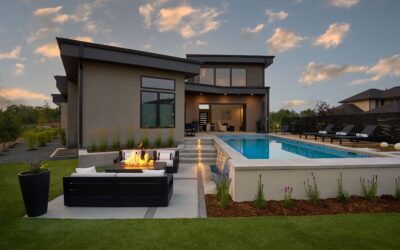
Lighting is one of the few things in an outdoor living space that cannot be judged from a drawing alone. The strongest schemes are designed from what the house, the trees and the hardscape actually do with light after dark, and built for the climate they have to survive.
Down to Earth Landscaping designs outdoor lighting as part of every Englewood, CO outdoor living project. Plan your outdoor lighting project with Down to Earth Landscaping.
In Summary
Can outdoor lighting be installed in Englewood, CO during winter?
Fixture and transformer work carry on in cold weather, but trenching stops, because frozen ground makes cable burial slow and messy and risks damaging finished surfaces. Winter is a good time to design and specify a system with Down to Earth Landscaping so trenching starts the moment the ground opens up in spring.
How long does a low voltage lighting system last at altitude?
Brass or copper housings with glass lenses and sealed connections outlast most of the landscape around them. The parts that age are lamps, which are replaceable, and anything plastic sitting in direct sun. The shortest-lived systems use stamped housings and pierce-point connectors, which tend to start failing in the third or fourth winter.
Does lighting have to be designed at the same time as the patio?
Lighting set into the hardscape has to be designed with the patio, because recessed step and seat wall fixtures need their sleeves and cable placed while the masonry is built. Freestanding path and uplight fixtures are more forgiving and can follow later, though running cable afterward still disturbs beds that were just planted.
Related: Need More Room to Lounge? Decking in Castle Pines, CO Can Extend Your Lifestyle Outdoors